The Death of Guan Yu — Where Did the Road to Maicheng Divide?
From Romance of the Three Kingdoms, Chapter 73 to Chapter 77
Jian'an 24, the year 219. Guan Yu of Shu lost Jing Province and lost his life. The explanation is always simple. Guan Yu grew arrogant, dropped his guard, and was struck from behind, it is said. But when Chapter 73 through Chapter 77 of the Romance are lined up and read, the view changes. On the road to his death, there were at least six turning points.
Chengdu's design and the warning that was brushed aside, the threatening words left behind and the city that did not fall. The young general's letter and the alarm that never sounded, and the reinforcements that never came, pile on top as well. If even one of them had been different, there might have been no road to Maicheng. Today, we will read this death not as Guan Yu's failure alone, but from the side of the accumulation.
Read the Comic
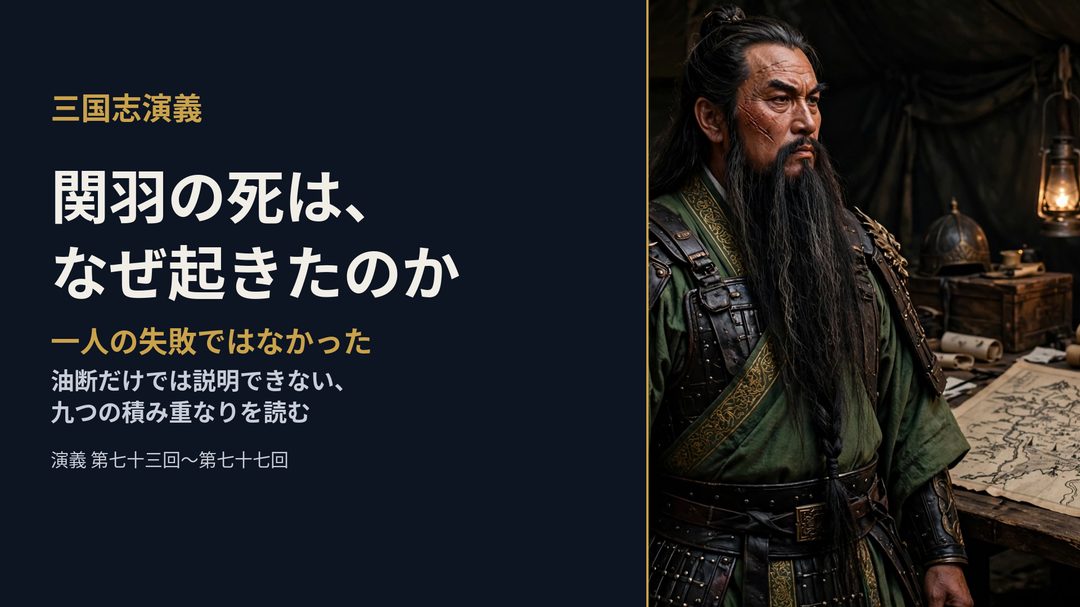
Wang Fu's Warning — The Three Men Who Could Not Be Replaced
The Marriage Proposal — The Tiger's Daughter's Words Hardened the Border
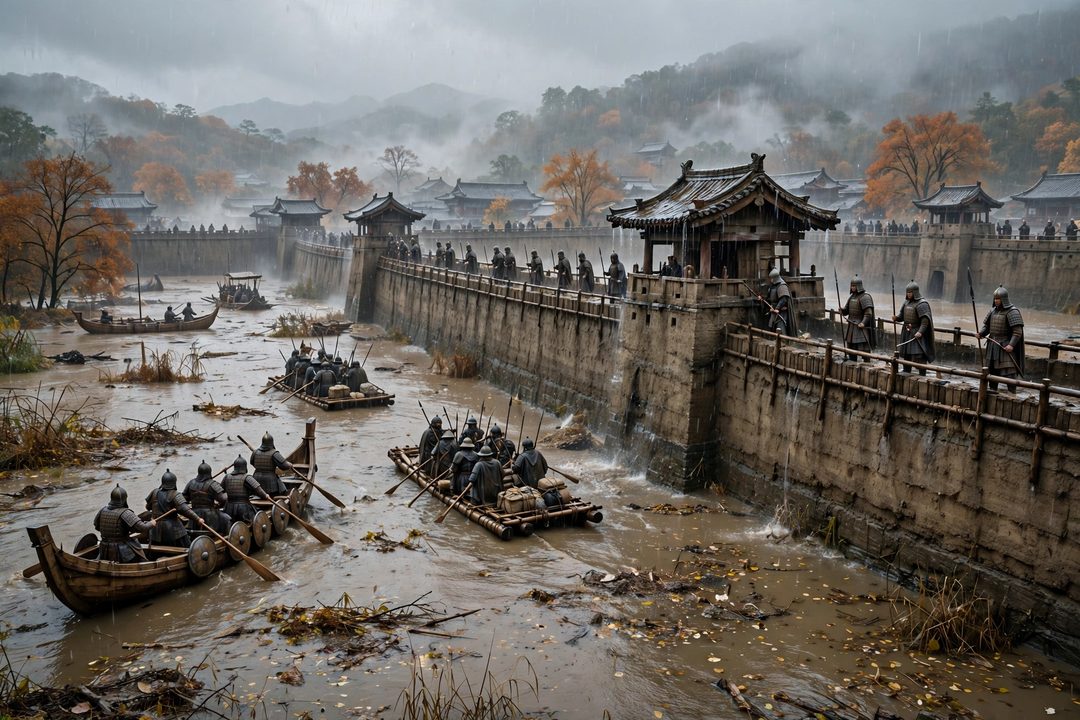
The Peak — Even Drowning the Seven Armies, Fancheng Did Not Fall
Lu Xun's Letter — Humility Drew the Soldiers Away
Crossing the River in White Clothes — The Alarm That Never Sounded
How It Collapsed — The Army Shrank Without Fighting
Reinforcements — The Two Armies That Never Came
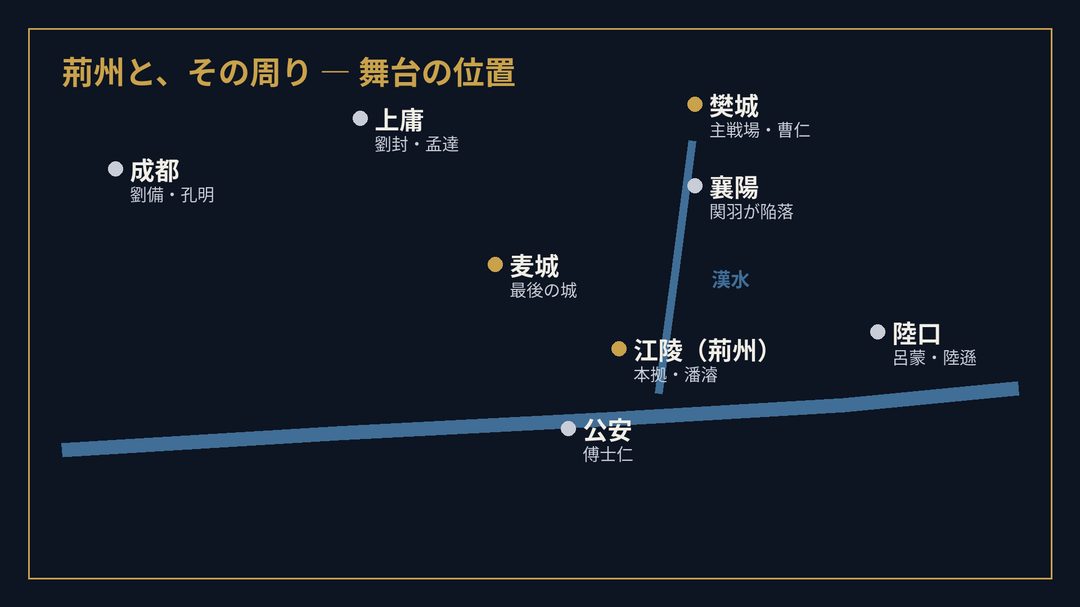
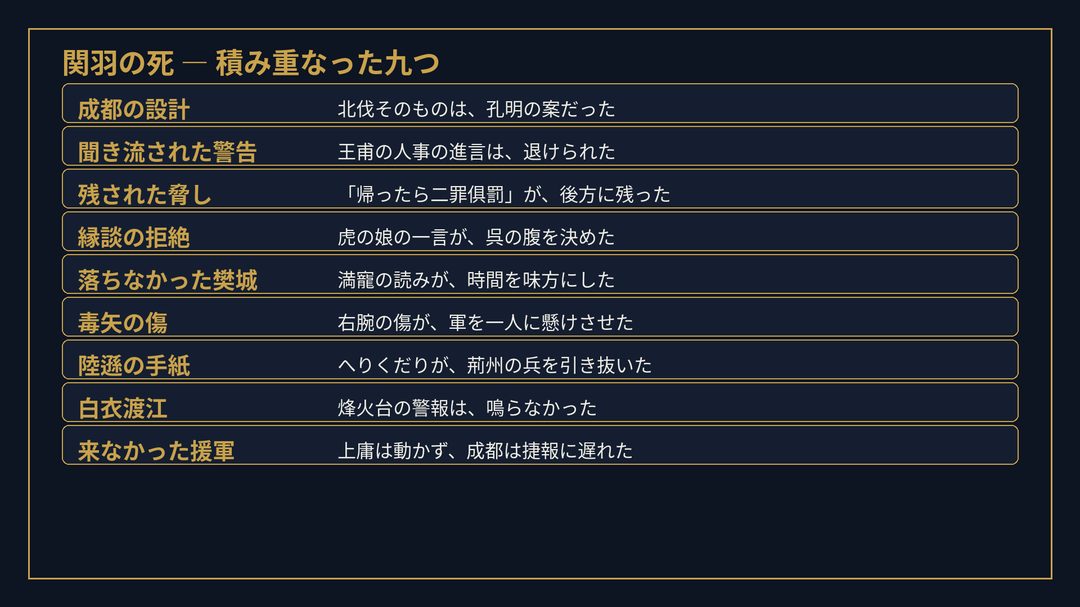
The End and a Summary — The Order in Which They Came Undone

Read the Text
Departure — The Northern Expedition Was a Design from Chengdu
The starting point was Chengdu's calculation. In Jian'an 24, Liu Bei became King of Hanzhong. Cao Cao joined hands with Eastern Wu, and a current formed in which they would come to take Jing Province. Kongming's reading was this: if we attack Fancheng first, the enemy will be frightened, and their plan will collapse. So Fei Shi delivered the official appointment, and Guan Yu was ordered to attack Fancheng.
In other words, the Northern Expedition was not a battle Guan Yu started on his own. It was the first great offensive that Liu Bei's entire kingdom bore. The attacking formation was decided. The vanguard was Liao Hua and Guan Ping; the main force was Guan Yu himself. The problem was the rear. Mi Fang in Nanjun, Fu Shiren in Gong'an, and Pan Jun was entrusted with holding Jing Province.
Against the placement of these three men, an objection came at once from right beside him. It was Wang Fu, the army's secretary. Wang Fu's warning is examined in the next section. To state the conclusion first: only half of it was heard.
Wang Fu's Warning — The Three Men Who Could Not Be Replaced
The first thing Wang Fu asked for was beacon towers along the river. Build towers every twenty to thirty li. It was a system in which, if Wu soldiers crossed the river, they would signal with fire by night and smoke by day, and this was adopted. His other counsel concerned people. Mi Fang and Fu Shiren, he said, might fail to discharge their defense.
Pan Jun is a jealous man who runs after profit, and is not suited to be governor of Jing Province, he said. If the loyal and honest Zhao Lei is placed there instead, there will not be one failure in ten thousand, he said. Guan Yu's answer was short.
Guan YuI know Pan Jun myself. It is already decided. Do not change it.
And on the night before the departure, an incident befell these two men. The two, who had been ordered to the vanguard, grew drunk on wine, set a fire, and burned up the military equipment and provisions. Guan Yu hauled the two out, and by Fei Shi's intercession, only the beheading was spared. In its place, he had them beaten forty strokes with a staff, took away the seal of the vanguard, and left these words:
On the day I return victorious, if there is even the slightest discrepancy, I will punish the two offenses together, he said. The two men, carrying fear and resentment, continued to hold the key to the border just as they were.
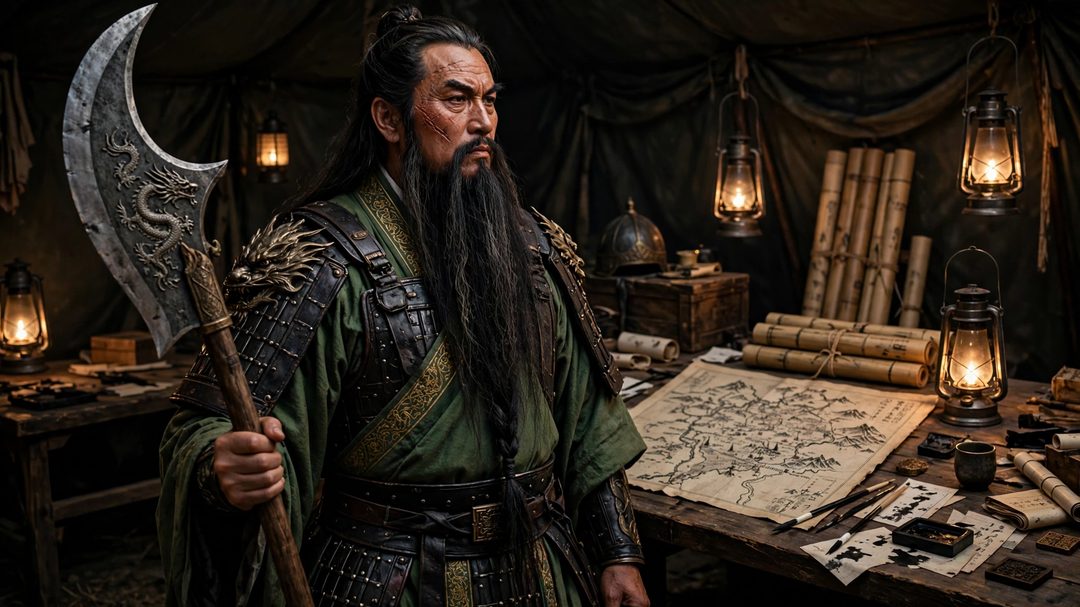
The Marriage Proposal — The Tiger's Daughter's Words Hardened the Border
There was one more seed of fire in the rear. The relationship with Sun Quan. Sun Quan first dispatched Zhuge Jin to propose a marriage with Guan Yu's daughter. If they were joined by marriage, they could break Cao Cao together. It was an invitation in that form. Guan Yu's reply was returned with anger. Would I marry my tiger's daughter to a dog's whelp? he said.
Zhuge Jin fled home clutching his head. Sun Quan was furious. Larger than the loss of face on the spot was that Wu's resolve was now fixed. If the marriage would not do, they would take Jing Province by force. Wu's course was set here. Around the same time, Guan Yu also once refused to accept the seal of the Five Tiger Generals, saying he was ranked alongside Huang Zhong.
Before the contest, both among his allies and outside them, the distance around Guan Yu was widening.
The Peak — Even Drowning the Seven Armies, Fancheng Did Not Fall
The first half of the battle was Guan Yu's solo stage. He took Xiangyang and besieged Fancheng. From Wei, Yu Jin's Seven Armies came to the rescue. The vanguard Pang De came carrying a coffin. In the eighth month, the autumn rains continued. Guan Yu dammed the outlets of the water and waited for the time. Yu Jin's army was massed in a low valley called the Zengkou River.
The water was released, and the flat ground sank to a depth of more than a zhang. The Seven Armies were almost annihilated. Yu Jin surrendered, and Pang De, who refused to surrender, was cut down. Guan Yu's name shook China. It was a momentum such that Cao Cao considered moving the capital — but Fancheng alone did not fall. To the defending general Cao Ren, Man Chong says:
Mountain water may come suddenly, but it does not last long, he said. In about ten days the water will recede. As that reading went, the city held out, and the siege dragged on. The longer it dragged on, the more the northern army kept consuming soldiers and provisions, and the more it thinned Jing Province's stores. In the midst of the siege, Guan Yu took a poisoned crossbow bolt in his right arm and fell from his horse.
The physician Hua Tuo performed an operation scraping the bone, and Guan Yu endured it to the end while playing Go. Even when his officers advised a withdrawal for recuperation, Guan Yu did not withdraw. A great enterprise must not be ruined over a small wound. The army advanced on, with everything staked on one man's body.
Lu Xun's Letter — Humility Drew the Soldiers Away
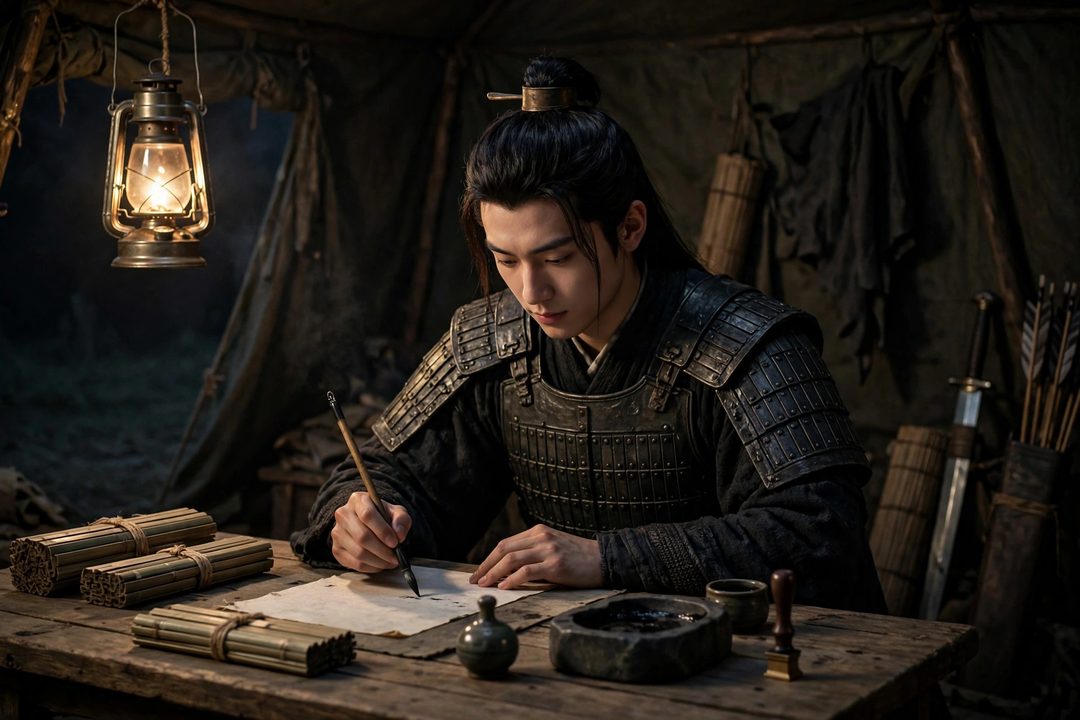
While Guan Yu was stalled in the north, another device was moving in the south. Lü Meng of Lukou disappeared from the public stage, claiming illness. This was a picture drawn by his successor, Lu Xun. Make it appear that I have withdrawn due to illness, and let him drop his guard, he said. Lu Xun was a young general with neither name nor achievements. He was a man outside Guan Yu's vigilance.
That Lu Xun sent a letter to Guan Yu. Its words were of the utmost humility. I am young and inexperienced, and no match for Guan Yu's fame. I wish for friendship between our two houses, the letter said. Reading the letter, Guan Yu looked up and laughed loudly. Sun Quan is shallow in discernment, to use such a child as a general, he said.
Then came the decisive move. Guan Yu drew most of Jing Province's soldiers away to the front line at Fancheng. The beacon towers remained. But the defending soldiers supporting them had grown thin. Lu Xun's humble letter, incidentally, is a move recorded in the official history as well. It is not an invention of the Romance.
Crossing the River in White Clothes — The Alarm That Never Sounded
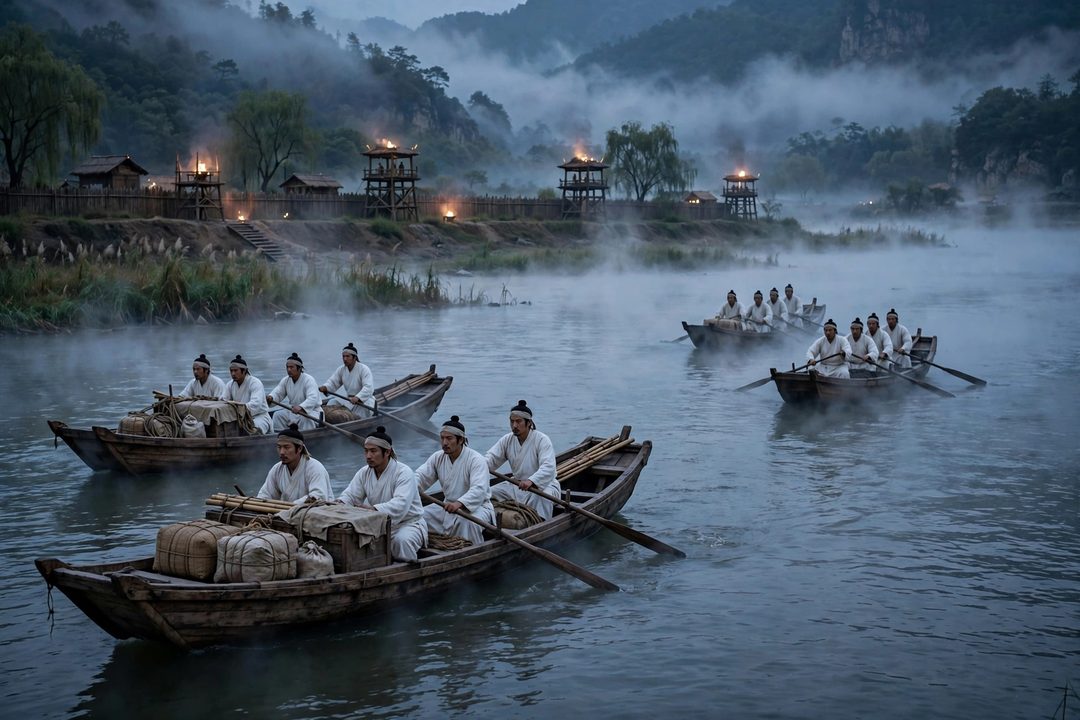
The report that Jing Province's soldiers had grown thin reached Sun Quan under the stars. Lü Meng checked 30,000 soldiers and prepared a little over eighty fast boats. He chose men accustomed to the water, dressed them in white clothes, and had them row in the guise of merchants. His elite soldiers were hidden in the holds of the boats. Seen from outside, they were merely merchant vessels.
As they approached the beacon towers on the riverbank, the merchants answered that they had been held up by the wind, and handed goods to the defending soldiers. The soldiers believed them and let the boats moor at the bank. The first checkpoint of the alarm thus fell silent. In the second watch, the elite soldiers in the holds came out all at once, bound the soldiers of the towers, and captured the guards of the beacon posts one after another.
Because not a single man was allowed to escape, neither fire nor smoke rose. The city of Jingzhou fell almost bloodlessly, its gates opened by the captured defending soldiers. Lü Meng enforced strict military discipline. Anyone who took even one thing of the people's would be punished under military law, he said. In fact, he tearfully executed a soldier from his own home region merely for taking a commoner's bamboo hat.
Guan Yu's family was protected in a separate residence. This very carefulness would create the collapse that followed.
How It Collapsed — The Army Shrank Without Fighting
On the northern front, his old friend Xu Huang was approaching with 50,000 soldiers. Xu Huang took the stockades of Yancheng and Sizhong one by one, with false banners and night attacks. Guan Yu and Xu Huang crossed bouts more than eighty times, but strength would not enter his right arm, where the wound remained. Then Cao Ren sallied from Fancheng, and Wei's pincer attack was complete.
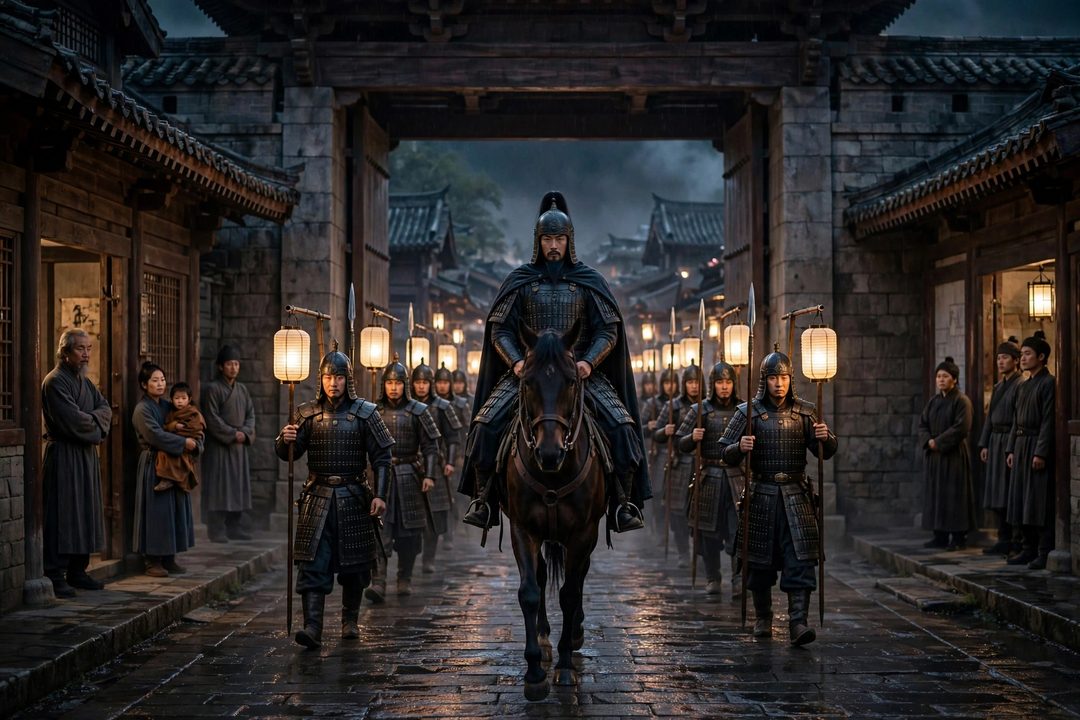
On the way back in retreat, the report caught up with him. Jing Province had been taken by Lü Meng, and his family was in their hands too. How did Nanjun and Gong'an fall? Mi Fang and Fu Shiren surrendered without fighting. Fu Shiren cut down Guan Yu's messenger, who had come to fetch provisions, persuaded Mi Fang, and brought him down. The reasoning brought out at that time was those words:
Lord Guan bears a grudge against us. If he returns victorious, there will surely be no forgiveness, they said. What collapsed further was the soldiers' hearts. Lü Meng courteously sent back a captured messenger. Their families were safe, and were being given provisions and doctors. That report went around the camp. The soldiers, learning their homes were safe, deserted one after another and went home to Jing Province.
Guan Yu's army did not shrink by fighting. Its destination home had been taken first, and its feet turned toward home.
Reinforcements — The Two Armies That Never Came
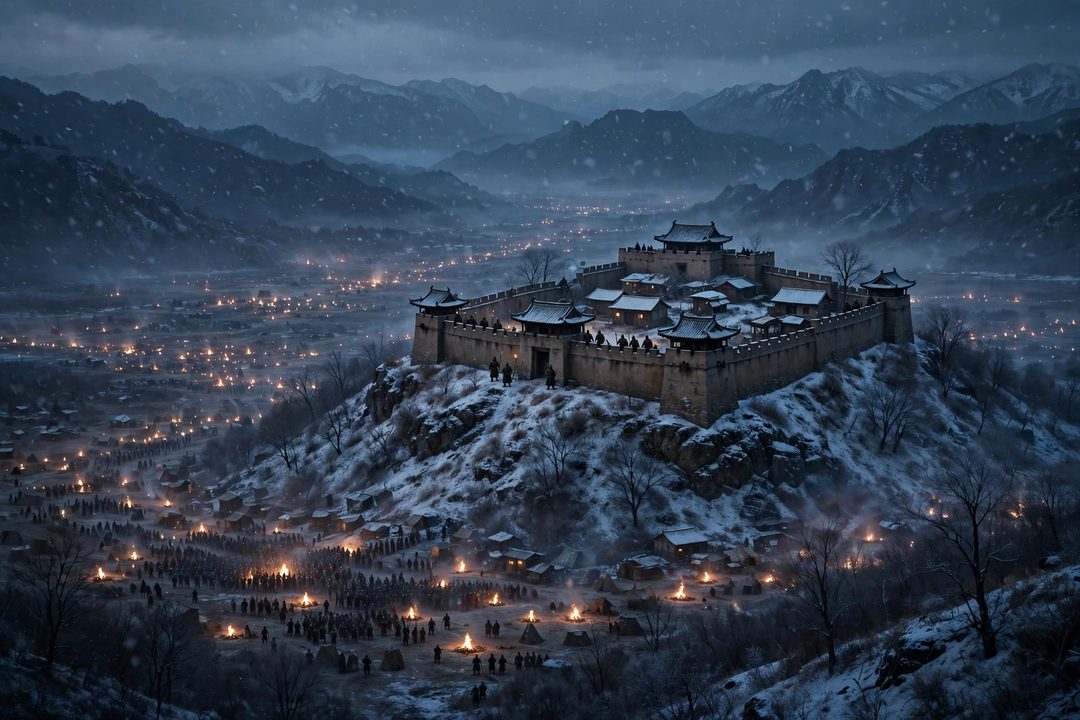
The soldiers remaining numbered a few hundred. Guan Yu entered Maicheng and took up a posture of waiting for reinforcements. One was Chengdu. Ma Liang and Yi Ji were racing through the night carrying three letters. The other was Shangyong, close at hand. The armies of Liu Feng and Meng Da were there. Liao Hua broke through the siege, rushed into Shangyong, struck his head against the ground, and begged for reinforcements.
Meng Da stopped him. Wu is strong, and Cao Cao's great army is near as well. The crowd of a mountain city cannot match them, he said. And he brought out Guan Yu's own words. Lord Guan is the man who called Liu Feng a foundling — that is, not his real son — and removed him from the succession, he said. The reasoning was: Lord Guan does not think of you, who call him uncle, as a nephew.
Liu Feng refused, saying the mountain city had only just submitted and the people's hearts were not yet settled. On Chengdu's side too, there was a gap. When Kongming heard of the refusal of the marriage proposal, he said: Jing Province is in danger. Lord Guan should be replaced and brought back. But right after that, reports of the victory of the Seven Armies drowned by water followed into Chengdu, and Liu Bei was put at ease.
The news of danger had arrived first. It was just that the news of victory was larger.
The Official History and the Romance — The Core Was on the Side of the Historical Record Too
Here, let us draw a line between the official history and the Romance. In the Biography of Guan Yu in the official history, the water that drowned the Seven Armies is not written as water Guan Yu released. It is recorded as a natural flood, in which the Han River overflowed in the great autumn rains. The physician who scraped the bone is not given Hua Tuo's name either. The place of the wound is also given, in the official history, as the left arm.
Conversely, both the Crossing the River in White Clothes and the surrender of Mi Fang and Fu Shiren have a core in the official history. Lu Xun's humble letter is not an invention either. That Guan Yu was cut down at Linju together with Guan Ping is also a record of the official history. In other words, the very core of an accumulation of factors also exists on the side of the historical record.
The Romance, on top of that core, fleshed it out with warnings, words, and scenes, and gave the reasons a visible form.
The End and a Summary — The Order in Which They Came Undone
At Maicheng, Zhuge Jin came to urge surrender. Guan Yu's answer did not waver.
Guan YuJade may be shattered, but its whiteness cannot be changed.
That night, Guan Yu broke out through the north gate. Lü Meng had placed ambushes on that small road. Zhu Ran with 5,000 men twenty li north of Maicheng. Pan Zhang with 500 men on the narrow path at Linju. Before the departure, Wang Fu had made a final counsel. There will be ambushes on the small road; you should take the main road, he said. Guan Yu's answer was this:
Guan YuEven if there are ambushes, what is there to fear?
At a place called Jueshi, the hooks and ropes of the ambush entangled the legs of the Red Hare. Guan Yu fell from his horse and was captured by Ma Zhong, an officer under Pan Zhang. Guan Ping too was captured, his strength spent. Jian'an 24, the twelfth month of winter. Guan Yu refused surrender before Sun Quan, and died together with Guan Ping.
Guan Yu was fifty-eight years old. Let us line them up. Chengdu's design, and the personnel warning that was brushed aside, and the threatening words left behind. The refusal of the marriage and Fancheng holding out, the poisoned arrow wound and Lu Xun's letter, and the Crossing the River in White Clothes. The army's hearts, undone by the generous treatment of their families, and the reinforcements that never came, pile on top.
If even one of them had slipped out of place, this ending might have been different. Guan Yu did not lose alone. The mechanism built around a strong general came undone, in order.
Sources and Basis
Source material
Based on Chapter 73 to Chapter 77 of Romance of the Three Kingdoms. Chapter 75 and Chapter 76 were checked against the text included in Wikisource, and Chapter 73, Chapter 74, and Chapter 77 were checked in full against another edition.
Distinguishing the Romance from the official history
The main line is constructed by checking the text of the Romance, and the points where it diverges from the official history are stated explicitly in a section within the main text.